Critical Thinking vs. Problem-Solving: What the Latest Data Says Learners Actually Need
We recently had a conversation with a PhD student from Rutgers University who is working on their dissertation focused on workforce readiness, particularly for individuals with disabilities. In our discussion, they paused when I described the distinction between critical thinking and problem-solving—it wasn’t a framework they had explicitly considered. That moment stuck with me. It pushed me to look more closely at why, at Founders Mark, we focus so intently on problem-solving—and why that distinction matters more than it seems.
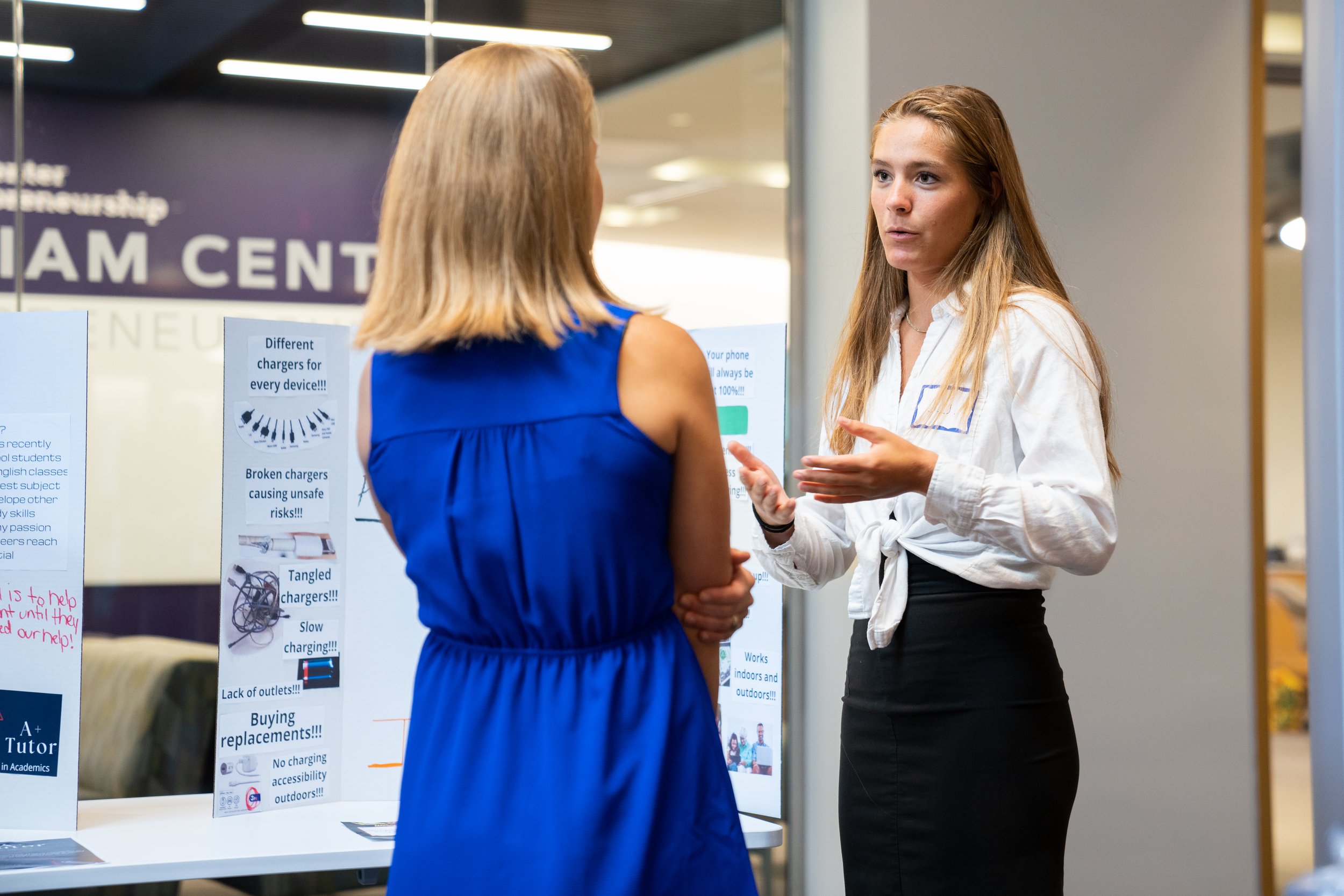
Two women talking
What is the difference between critical thinking and problem-solving?
Critical thinking is the ability to analyze, evaluate, and question information.
Problem-solving is the ability to act on that thinking—testing ideas, learning from results, and improving outcomes.
They are connected—but not equal.
Critical thinking is the input.
Problem-solving is the input + the output.
What the most current data tells us
The latest insights from the World Economic Forum continue to reinforce a clear trend:
From the Future of Jobs Report 2023:
Analytical thinking remains the #1 core skill
Creative thinking and problem-solving are in the top 3 skills
44% of workers’ core skills are expected to change by 2027
Employers increasingly prioritize skills that require application, not just knowledge
Source: https://www.weforum.org/reports/the-future-of-jobs-report-2023/
Research from America Succeeds further shows:
Durable skills appear in ~70% of job postings
Problem-solving is one of the most consistently requested competencies
Source: https://www.durableskills.org
The implication is clear:
Learners who can apply thinking in real situations will have a measurable advantage.
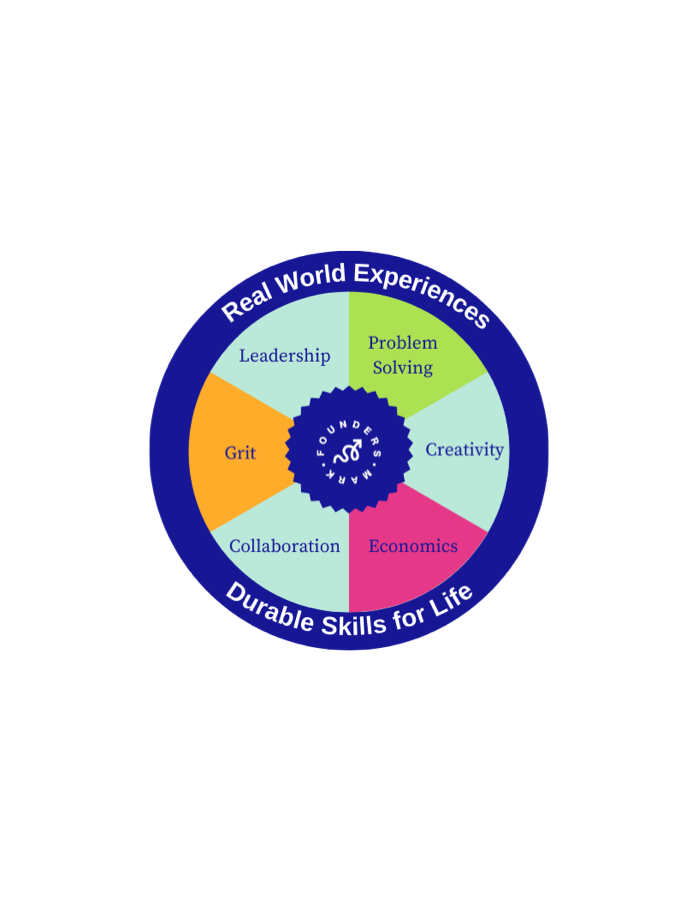
Founders Mark Durable Skills Wheel
The gap: schools build thinking, not enough doing
Most classrooms emphasize:
Analyzing information
Producing correct answers
Demonstrating understanding
These are critical thinking skills—and they matter.
But they often stop short of:
Testing ideas in real contexts
Adapting based on feedback
Delivering outcomes that affect other people
That’s where problem-solving lives.
Why is friction required for real skill-building?
Problem-solving introduces something most classrooms avoid: friction.
Friction looks like:
Ambiguity (no clear right answer)
Constraints (time, resources, competing priorities)
Real feedback (from users, customers, or stakeholders)
This friction forces learners to:
Make decisions without certainty
Adjust based on what actually happens
Learn faster through experience
Without friction, learning stays theoretical.
With friction, learning becomes transferable.
Why reps matter more than knowledge
You cannot build problem-solving through a single experience.
Leaerners need:
Repeated cycles of action → feedback → iteration
Opportunities to solve different types of problems
Exposure to real consequences and outcomes
Over time, they develop:
Pattern recognition
Judgment
Confidence in uncertainty
They shift from:
“What do I think will work?” → “What have I seen work?”
That shift is what employers are actually hiring for.
Access: moving beyond grades to real capability
Grades reflect performance in controlled environments.
Problem-solving creates access in the real world.
When learners can:
Build something that works
Solve a problem for real people
Show measurable outcomes
They create proof of ability.
That proof:
Strengthens resumes and interviews
Builds credibility beyond academics
Opens doors in a changing job market
What to do next
If we want to align preparation with the future of work and life:
1. Integrate real-world problem-solving
Give learners opportunities to solve problems that matter beyond the classroom.
2. Design for iteration
Prioritize cycles of testing and improvement over one-time performance.
3. Increase reps
Skill comes from repetition, not exposure.
4. Introduce productive friction
Ambiguity and constraints should be part of the learning process.
The bottom line
Critical thinking is essential.
But on its own, it’s incomplete.
Problem-solving is what turns thinking into results.
And according to the most current workforce data,
those who can consistently turn ideas into outcomes will be the ones who succeed.
Give learners the reps.
Give them the friction.
Give them the chance to solve something real.